Stop Dog and Puppy Jumping Up
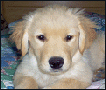
The Biggest reason a puppy or dog jumps up on people ...
To say hello, of course. Puppies are social creatures and happy and excited to greet just about anyone! Jumping, leaping and bouncing are ways your dog shows affection and receives attention. When a puppy is very young, we usually sit on the floor, let them wiggle into our laps and allow them to lick and nuzzle up close to our face. This is OK because we are down at their level.
However, when we are standing or sitting in a chair and they come bounding over to greet us, jumping up on us and trying to reach our face, we must not bend over and exchange hugs and kisses. If we do we are training and rewarding the puppy for jumping up. Eventually, most of us decide we no longer like our puppy jumping up to say hello - usually when the puppy gets bigger and more rambunctious. What used to be cute is now obnoxious and even dangerous if the puppy is jumping up on children or the elderly.
Why the jumping up problem continues...
Our inconsistency perpetuates the problem. Some of the time we tolerate the jumping and ignore it. Other times we reward the behavior by exchanging enthusiastic greetings. But when we're dressed up and the puppy's paws are muddy, it's a different story. Reprimanding the puppy for jumping up usually does not work. Either the puppy misunderstands the reprimand as praise or he gets even more excited and the jumping gets worse. If the reprimand is severe enough, the puppy may stop jumping at that moment but it doesn't solve the problem altogether; and it certainly is not a very nice thing to do. It's very similar to a person approaching you with a big smile, arm extended to exchange a hand-shake and you bopping the person in the nose. Even if your puppy learns that jumping up on you is not a good idea, he will usually get away with jumping up on everyone else.
How to Stop the Jumping Up Problem...
The solution to the jumping up problem is providing your dog with an alternative method of greeting you and others. Teach your dog to sit-stay. He cannot sit-stay and jump up at the same time. When he is sitting you can then kneel down and give him a warm hug and kiss.
Also, it's your job to never let anyone else allow your puppy to jump up on them! They will say, "It's OK, she's just a puppy, I don't mind if she jumps on me". You must rush in and pull the puppy down immediately, put your pup in a sit, praise the puppy then scold the person ! Continue to hold the puppy in a sit and let the person greet the pup. Explain to them they can never allow the puppy to jump on them - the puppy must sit to be greeted. To stop the jumping up behavior in pups, I do as much people training as puppy training!
Practice is essential. If your dog is excitedly jumping up when you return home from work and this only happens once a day, then he is only getting one practice session a day. If he is jumping up on your company and you only have visitors once a week, then he is only getting one practice session a week.
In order to perfect the proper greeting routine, your dog needs much more practice than that. You can speed up the training process by leaving through the back door and returning through the front door over and over again. When your friends come over, have them do the same. Each time, ask your dog to sit-stay before opening the door. At first his excitement will make it difficult for him to concentrate but after you've repeated this process 10 times, he will calm down and be able to concentrate. Before asking your dog to sit-stay in this distracting and exciting situation, be sure he has a reliable sit-stay in normal, non-stressful situations. And of course you can always just hold the dog in a sit if need be.
Remember, Jumping up can be dangerous as well as annoying. Just as many owners are sued for their jumping dogs as their biting dogs. Young children and elderly people can easily be toppled over and seriously injured by exuberant, friendly dogs. Start now to teach your puppy not to jump up. Even little dogs can cause problems and injury to themselves and others when they jump up.
Golden Rules to Stop a Puppy or Dog from Jumping Up
• Be consistent.• Get down to his level to give affection and attention.
• Do not pet, talk, cuddle or reward your puppy for jumping.
• Do not allow other people to let your puppy jump on them.
• Do not give in! Do not give up!
Stop Dog and Puppy Jumping Up
Recommend this webpage... share with friends !These articles may also be of interest...
^ Top of Page